Phone Use and Sleep Among Students
20 Feb, 2026
A survey of 34 Romanian teenagers on screen time, sleep quality, and the patterns we can't ignore.
Introduction
Tell me honestly:
How many times have you heard someone talk about teenagers, phones and sleep?
Was it once, briefly, while drinking your coffee, thinking: "Yeah... this generation really has no self-control"?
Was it a dramatic, yet informative, news story that warned you about blue light destroying your brain?
Or maybe you've heard it so many times you just roll your eyes now. Change the channel. Scroll past it. Another day, another headline blaming young people for existing in the digital age.
And yet, how often did anyone actually ask us what our nights look like? How often did anyone try to understand the reality behind the stereotype?
That's why I decided to look into it myself.
Not as a scientist in a lab coat, not even close, but as a student living through it: the late-night scrolling, the group chats that never sleep, the homework done under a blanket, the "just five more minutes" that turn into an hour.
I surveyed students, between the 16th and 26th of November 2025, to find out what's really happening between phones and sleep. No exaggerated story, certainly not the moral panic, but the honest patterns of our everyday lives.
A total of 34 students participated in the survey, answering questions about demographics, daily phone use, nighttime routines, and how rested they feel. Their responses were cleaned, translated and formatted in order to analyze possible patterns between phone behavior and sleep outcomes.
Part I: Why I Looked Into This
1. My Relationship With My Phone
1.1. Why "addicted" never felt right
I've always been told — sometimes softly, sometimes jokingly, sometimes with a raised eyebrow — that I'm a little too attached to my phone.
For a long time, I didn't understand what people meant.
I went outside regularly.
I'm sociable and funny (even if socially awkward by default, that's a factory setting).
I make time for my responsibilities, for school, for my family.
I'm productive, I hate leaving things for tomorrow, and although procrastination does catch me sometimes, it's not my entire personality and I think I push through it fairly fine.
So why "addicted"?
Why that word, when I was doing everything I was supposed to?
It took me a while to realize the obvious: people were looking from the outside, with a completely different frame of reference.
Adults grew up with different tools, different ways to cope. They assume phones mean "distraction", "laziness", "doom"...Maybe even "danger".
But for me, my phone is also where I write.
Where ideas land at midnight, where drafts live, where poems and thoughts get captured before they disappear.
I've always loved movies. Growing up in a cinephile family meant films were basically a second language in our house. And yes, sometimes the easiest way to watch one is on my phone, squeezed between homework, projects, and life.
Not everything needs a laptop, a rented copy, or the "perfect setup".
And books? Same story.
When I was younger and my mom took me to the mall, I didn't run to the toy store. I tugged her toward the nearest bookshop like it was a magnet. No one told me to, reading just felt like home.
These days, I sometimes read digitally. It's practical. It means I can sit on the balcony on a cold autumn night, lost in a story, without waking the whole house by turning on every lamp.
I learned Python on my phone.
I stay close to friends from different schools that I haven't seen for months, all because of my phone.
Where I keep everything organized and ready to go.
A phone gives accessibility.
A phone gives flexibility.
A phone gives media, connection, creativity... all in one tiny device.
It's not just a distraction. It's a tool.
And yet, some people don't see it as such.
1.2. The question no one asks
There's this idea floating around that phones are the problem.
The villain.
The thing ruining us.
The question I put forward with this article is: Is it, though?
Every time I hear another news segment claiming that all teenagers do is scroll on their phones — and that the solution is to confiscate devices entirely — it stings in a way I wish it didn't. Not because the statement is entirely false: phones can be addictive, distracting, even dangerous. Not because teens are flawless. Just because the narrative feels deeply unbalanced.
Why is our mental health a secondary topic? Why don't we talk about it with the same urgency as our screen time?
Why is the phone blamed first, loudest, and longest?
Is it really the monster in the room, or simply the easiest thing to point to?
Many adults recommend strict screen-time limits, yet high-school students routinely exceed them out of necessity: online assignments, research, messaging classmates, or organizing group projects. The reality is that not every young person uses technology in the same way.
And yet the public discourse still treats us as a single, uniform problem. We're all still boxed into one image: children who don't know joy, who can't manage time, who don't struggle in "real" ways.
Under those assumptions, some of us stop attempting to correct the narrative. Instead, we rebel in quiet ways: staying online longer, pretending nothing affects us, slipping away schoolwork because encouragement is rare and criticism is constant. Trying to appear different, even if we don't find ourselves in those actions, just for the sake of it.
The conversations adults have about us happen above our heads, and yet somehow still miss the point.
They're unfinished.
And sometimes, painful as it is to admit, they're wrong.
2. What I Set Out to Learn
That curiosity is what started everything.
I wanted to know if it was just me.
If other teenagers felt the same quiet tension with their phones, or not.
If our relationship with them was more complicated than labels like "addicted" or "lazy".
I wasn't looking for blame.
I was looking for understanding.
I wanted data, not assumptions. Patterns, not stereotypes.
So I created a small anonymous study. Run by a teenager, for teenagers. No judgment. No pressure. No adults hovering behind our shoulders. I wanted to see the truth behind the headlines with my own eyes, even if that truth turned out to be messy.
Part II: What I Found
3. The Data: Patterns in 34 Student Lives
This study examined patterns of smartphone use among students and their relationship with sleep-related outcomes. Data was collected through an anonymous questionnaire completed by 34 participants. The survey included questions related to demographic characteristics, daily phone use behaviors, phone activities, and subjective sleep outcomes.
3.1. Who answered
The study sample consisted of 34 students. Most participants identified as female (n = 25), while a smaller proportion identified as male (n = 3) or preferred not to state their gender (n = 6). The mean participant age was approximately 16 years. The median previous-year academic grade was 9.6, indicating generally strong academic performance within the sample.
A large proportion of participants (68%) reported using their phone in bed either always or often, suggesting that bedtime phone use is a common behavior among the surveyed students.
These characteristics are summarized in the descriptive tables presented in the study overview section.
If you want to see more stats and the full process behind this research — the raw data, the mappings, the charts — feel free to take a look at the spreadsheet.
↓ Download the dataset3.2. How we use our phones
Daily phone use was measured using coded categories representing increasing levels of use. The average daily phone use score was 3.15, with a median value of 3, indicating that most students fell within moderate-to-high phone use categories.
As illustrated in the Daily phone use (hours) column chart, the largest group of participants reported using their phones between 3–5 hours per day (n = 19). A notable proportion of students exceeded 6 hours of daily phone use (n = 10), while fewer participants reported limited use of 1–2 hours per day (n = 5). This distribution suggests that extended daily phone use is common within the sample.

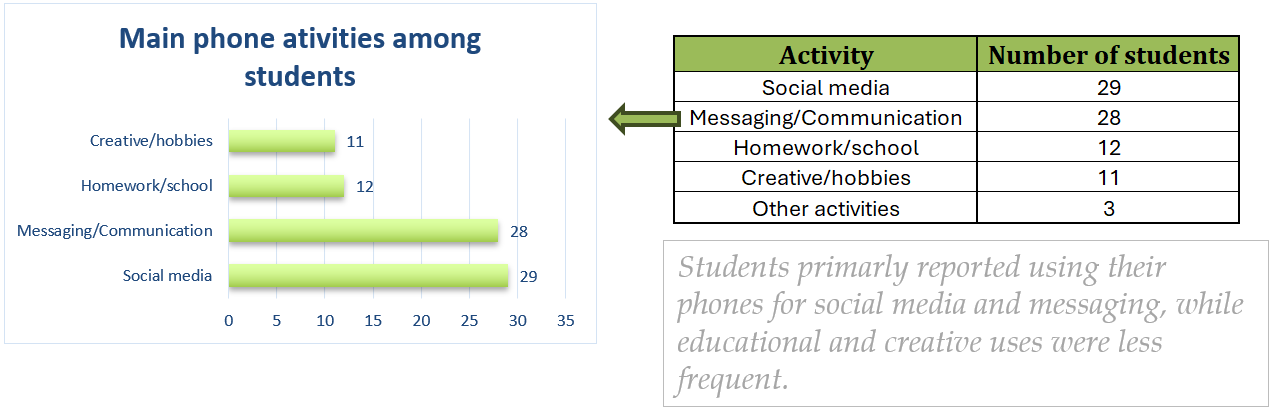
Phone activity patterns were also examined. The horizontal bar chart showing Main phone activities among students indicates that social media (n = 29) and messaging/communication (n = 28) were the most frequently reported uses of smartphones. In contrast, activities related to homework or school (n = 12) and creative or hobby-based use (n = 11) were reported less often. Only a small number of participants selected other activities (n = 3). These results indicate that smartphones were primarily used for social interaction rather than academic or creative purposes.
3.3. How we sleep (or don't)
Sleep-related variables were measured using self-reported rating scales. Overall sleep quality was rated on a scale from 1 (very poor) to 5 (very good). The average sleep quality score across participants was 3.56, indicating moderate sleep quality. Morning tiredness, measured on a similar 1–5 scale, had an average score of 2.94, suggesting that many students experienced some degree of tiredness upon waking, even after a fairly decent sleep.
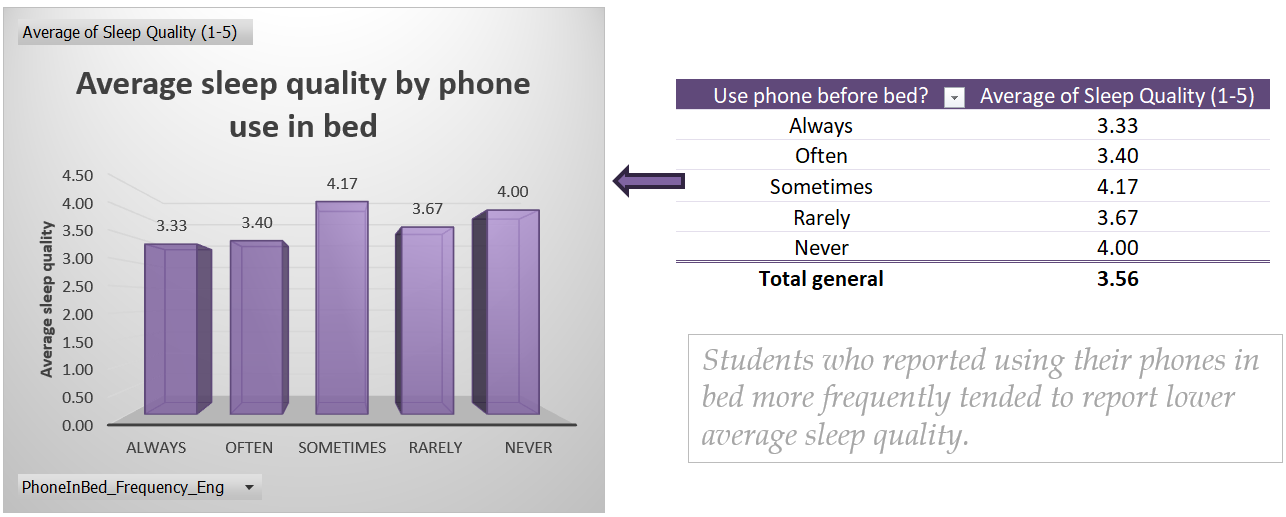
Sleep outcomes were further analyzed in relation to bedtime phone use frequency. As shown in the column chart titled Average sleep quality by phone use in bed, students who reported always using their phone in bed demonstrated lower average sleep quality scores compared to those who reported rarely or never using their phones before sleep. Participants who reported sometimes using their phone in bed showed the highest average sleep quality, while the lowest average values were observed among those reporting consistent bedtime phone use.
These findings suggest observable differences in sleep quality across different bedtime phone use behaviors.
3.4. The connection between the two
‼️Observation:
Before diving into the numbers, it’s worth pausing to explain one key idea: correlation.
Correlation measures how strongly two factors are related. Its values range from –1 to +1, and they can be:
In this study, correlations were weak, suggesting that phone use alone does not determine sleep quality. Instead, sleep appears to be influenced by multiple factors.
This suggests that while phone use may play a role in sleep quality, it is only one piece of a much larger puzzle. Stress, school workload, mental health, routines, and environment likely matter just as much... if not more.
Rather than proving a single cause, the data points toward something more realistic: sleep and technology exist in a complex relationship shaped by many factors.‼️
To explore potential relationships between smartphone use and sleep outcomes, correlational analyses were conducted using numerically coded variables.
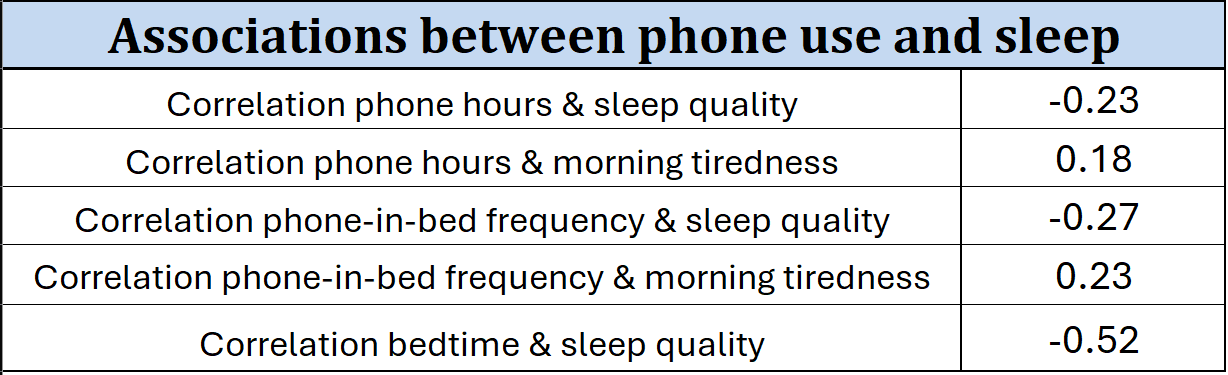
A weak negative correlation was observed between daily phone use and sleep quality (r = −0.23), indicating that higher daily phone use tended to be associated with slightly lower perceived sleep quality. Similarly, a negative association was found between phone use in bed frequency and sleep quality (r = −0.27), suggesting that more frequent bedtime phone use corresponded with poorer sleep quality ratings.
A positive correlation was identified between daily phone use and morning tiredness (r = 0.18), implying that students who used their phones more during the day tended to report greater tiredness in the morning, although the relationship was weak.
The strongest association observed in the analysis was between bedtime phone use and sleep quality (r = −0.52), representing a moderate negative correlation. This indicates that increased phone use close to bedtime was linked with noticeably lower sleep quality scores among participants.
Overall, while several correlations were weak in strength, consistent negative trends were observed between phone-related behaviors, particularly bedtime phone use, and sleep outcomes.
4. What the Numbers Actually Mean
You've probably realised already that the results of this study do not point to a single dramatic conclusion, nor do they suggest that smartphones are inherently harmful. Instead, they reveal something quieter, and perhaps more uncomfortable: how deeply phones have woven themselves into everyday student life, especially in moments meant for rest.
Most participants reported spending several hours per day on their phones, with social media and messaging dominating usage. This is not surprising. Phones are no longer simply tools for entertainment; they are social spaces, emotional outlets, and constant companions. For many students, being online is not a choice made consciously, it is the default, "required" state to fit in.
What becomes more concerning is not phone use itself, but when and how it occurs. The data consistently showed that phone use before bed was associated with lower sleep quality. Students who used their phones in bed more frequently tended to report worse sleep, and this relationship was stronger than those observed for general daily phone use. In other words, it is not only how much time is spent on phones, but how closely that time surrounds sleep.
This matters because sleep is not just rest, it is recovery. Poor sleep affects concentration, emotional regulation, motivation, and long-term health. Yet many students appear caught in a pattern where bedtime becomes another extension of the online day: scrolling, replying, watching, consuming, even while physically exhausted.
Importantly, these findings should not be interpreted as blame. The results do not suggest a lack of discipline or responsibility on the part of students. Not in the slightest, if we take the previous year's mean grade into consideration. Instead, they reflect a broader digital environment built around constant engagement. Notifications, endless content feeds, and social pressure to stay responsive make disconnection increasingly difficult. When a phone is designed to demand attention, choosing rest can feel like going against the system itself.
The correlations observed in this study were not extreme, but their consistency is meaningful. Small effects repeated across many individuals can still shape daily life. Feeling slightly more tired each morning, sleeping slightly worse each night... Over time, those "slight" differences accumulate.
What this study ultimately highlights is not a crisis, but a tension: a generation growing up hyperconnected while quietly sleep-deprived. The phone is not the enemy, but its place in our most vulnerable hours deserves more attention.
Understanding these patterns is the first step toward awareness. And awareness, unlike restriction or guilt, creates the possibility of choice.
5. Voices From the Survey
To complement the numerical data, participants were invited to describe in their own words whether and how phone use affects their sleep, or to identify other major factors that interfere with rest. These anonymous responses provide insight into the lived experiences behind the statistics.
5.1. "My phone affects my sleep"
Several participants described difficulty falling asleep without background media, particularly videos or audio content:
I personally can't fall asleep unless I watch or at least listen to a YouTube video. I can't sleep in total silence, so I need something talking in the background.
Others reported physical discomfort associated with screen use:
The screen light affects my eyesight, especially because I hold the phone very close to my eyes.
My eyes hurt from the screen light, even when the brightness is at minimum.
My eyes feel strained.
Some responses also reflected awareness of the impact of blue light on sleep:
Blue light affects your ability to fall asleep.
One participant linked phone use to broader well-being:
Lower immunity and lack of motivation.
Common themes among these responses:
These comments suggest that the issue is not only time spent on phones, but the sensory and physiological effects of late-night screen exposure.
5.2. "It's not my phone, it's my mind"
Participants who did not view phones as the main factor overwhelmingly identified stress, anxiety, and overthinking as major barriers to sleep.
Many responses focused on emotional and mental strain:
Probably stress from things happening in my life and a bit from school. If I start thinking about stressful or upsetting things, I can't sleep or I have nightmares.
Worries.
Anxiety.
Personal problems.
Thoughts.
The voices in my head that won't stop.
Academic pressure also emerged as a recurring theme:
Stress when I know I have a test the next day.
Waking up early in the morning.
Other factors mentioned included schedule disruptions, exhaustion, and other devices:
I've been feeling exhausted every evening lately… I fall asleep quickly unless my schedule suddenly changes or I think about things that bother me.
The computer.
Common themes among these responses:
These responses highlight that sleep challenges are multifactorial. Even when phone use is not perceived as the primary cause, digital devices, academic demands, and mental health pressures all interact to shape sleep quality.
5.3. Why these voices matter
While quantitative data reveals patterns, these testimonies show the complexity behind them. Students are not simply "using phones too much". They are coping with silence, stress, expectations, and emotional strain. For some, the phone is a source of stimulation that delays sleep. For others, it is a distraction from intrusive thoughts. In both cases, it plays a role in how young people navigate rest in an increasingly demanding environment.
Part III: The Bigger Picture
6. The Hypocrisy We Don't Talk About
6.1. Adults Struggle Too
6. The Hypocrisy We Don't Talk About
6.1. Adults Struggle Too
Here's the part no one likes admitting: it's not just teenagers who struggle with screens.
Adults fall into rabbit holes too. They lose sleep doomscrolling on Facebook about political arguments and debates. They binge Netflix until "next episode?" becomes "it's 3AM?". Teachers have to answer emails at midnight. Candy Crush has entire armies of 40-year-old women burning retinas, brightness on max, just to get that one more life, or that next level.
Not because they're irresponsible, but because they're tired. Because life is really heavy sometimes, and they don't always know where to put it. And honestly, I understand them.
Sometimes I think adults scroll not because they're addicted, but because it's the only quiet moment they get. Because they have entire worlds to hold up: work, bills, kids, relationships, aging parents, homes to maintain, emotions they were never taught to express. A hundred invisible responsibilities.
Many of them grew up in times where mental health wasn't even a conversation, it was just something to "push through" that "happened to everyone". Of course a phone becomes a pocket-sized escape. Of course sometimes it's easier to tap a screen than sit with exhaustion.
They escape into screens the way we do, not because we're all weak and distracted, but because we're human. Us, teenagers, are not the only ones struggling for balance. We're just the ones most often pointed at.
6.2. The Double Standard
I want to clarify one thing: I'm not writing this to point fingers myself. If anything, I'm trying to open my hands and offer this to anyone who's willing to listen. I don't want a fight between generations, just a conversation. I can't speak for adults, because I'm not one yet, but I can speak as a teenager who often feels misunderstood. I know what it's like to hear "you're always on that phone" and think, if only you knew why.
So here's my honest take: sometimes the narrative about teens and phones feels a little unfair. I daresay, hypocritical.
Yes, our generation uses phones a lot. Yes, it's easy to scroll longer than we should. But we also use them to learn, to create, to stay informed, to do homework, to keep relationships alive, and our world (as we know it) functioning.
I spent over 20 hours on this entire project, probably longer than it should've taken me. Writing the survey, collecting answers, cleaning data, formatting, analyzing, and every other part of it happened through a screen. My grades depend on screen time. My assignments live online. Even this article exists because my phone let me write the drafts I needed when inspiration came at midnight.
Phones do affect sleep, denying that would be dishonest. My data shows that clearly, especially when used late at night. But they're not the whole story. In fact, pretending that it's the only villain is lazy storytelling. Blaming the phone alone is like blaming the pencil for a failed exam... it ignores everything around it.
6.3. What's Really Keeping Us Awake
There's one topic that rarely makes it into conversations about teens and phones, even though it's impossible to separate it: our mental health.
Not in the dramatic headlines, not in the "kids nowadays" discussions, not even always in our own homes. It's easier to count hours on a screen than the invisible things that weigh on us: deadlines, anxiety, loneliness, comparison, fear of failure, friendships that feel unstable, the pressure to "turn out right".
Teenagers aren't a single group. We are not an entity. Some of us are ambitious, some exhausted, some lost, some thriving. We cope differently, we prioritize differently, and what overwhelms one person barely scratches another.
But most of us, at least once, feel the noise of it all: the stress of school, the constant "your future depends on this", the late-night panic spirals, the feeling that everyone else is doing so much better.
Phones can be a distraction, yes... but sometimes they're also a lifeline, a break, a friend, a window out of our heads.
And in the last few years, everything intensified. The pandemic rewired how we socialize. Isolation became normal. Some of us experienced loss, uncertainty, and fear at ages we were supposed to only worry about grades and crushes. We had access to the entire internet before we had the emotional tools to handle all of it: news violence, body image standards, trends, adult topics, the endless comparison carousel. Many of us grew up online faster than we grew up offline.
We don't always talk about these things. Not at school, not at home, sometimes not even with each other. It's hard to admit feeling overwhelmed in a world that expects teenagers to be either perfectly responsible or effortlessly carefree. It's also hard to connect with adults when conversations start with "when I was your age..." instead of "help me understand what it's like for you".
I reiterate: this is not about saying adults don't struggle, they do. Deeply. They carry responsibilities we barely understand. But pretending teens are carefree creatures who only need "less phone" is too simple for reality.
Data already shows it: in Romania, the youth suicide rate is 50% higher than the European average, and post-pandemic reports show rising anxiety, depression, and burnout among adolescents.
We talk less. We feel more. And nobody asks why, as long as the phone takes the blame.
Blaming screens is easy, understanding pain is harder. These problems? They don't disappear when you turn off the Wi-Fi. That's why reducing everything to "phones ruin teenagers" misses the bigger picture. Phones may affect our sleep, yes. But mental health affects it too. Stress affects it. Life affects it. The screen is the surface, not always the root. It's a symptom, not the illness.
6.4. Meeting in the Middle
I'm not here claiming, pretending, I have the answer... I'm sixteen. I don't hold solutions to global issues or generational divides. What I do have is perspective. I'm paying attention. I'm living this experience in real time, like many teenagers who pour their worries into Reddit threads, tweet their thoughts at midnight, or film three-minute confessions into a front camera for TikTok, because they don't know who else will listen.
We're not doing it to drag adults into a debate, nor to prove we're victims. Definitely not to spark some dramatic Gen Z vs. Boomer/Gen X/Millennial showdown, either. That's not the point. My intention isn't to criticize, but to contribute. To say, hey, something is happening here, can we talk about it without hostility?
I see where adults are coming from. They lived through different pressures, different limitations, different rules. Many carried burdens in silence because therapy wasn't normal, crying was weakness, and you didn't talk about pain unless you wanted to be called dramatic. They survived through resilience that I honestly admire. But our world? The one we're growing up in? It moves faster, hits louder, exposes us earlier. And neither side is wrong for struggling with it.
I don't expect everyone to agree with me. We won't always see eye to eye, and that's okay. What matters is that we try. Because if we keep dismissing each other, if adults label us as addicted and careless, and teens roll their eyes at every parental concern, we stop seeing each other as people and start seeing each other as problems.
I just want us to recognize each other more. To notice the weight we all carry, even if it looks different on each back. To meet somewhere in the middle, with empathy instead of accusation. If we hope for understanding, we need conversation. Not blame. Not mockery. Just honesty and willingness.
If we refuse to listen, really listen, then what future are we building? Where does connection go? How do we grow, if every generation keeps fighting to be right instead of trying to understand?
7. How Tech Culture Shapes Us
7.1. We didn't build this system
Teenagers are often told to "just put the phone down", as if the digital world was a personal choice, something we consciously opted into and could just as easily opt out of. But the truth is simpler, and more uncomfortable: we didn't design this environment. We grew up inside it.
No teenager built the systems we now live in, and none of us could honestly claim otherwise. The digital world didn't arrive with a warning label or a vote. It became normal quietly, gradually, and then all at once. It was faster, easier, convenient. A way to soothe crying babies, to keep track of children, to communicate across distance, to learn, to search, to organize life. What started as a tool slowly became infrastructure.
Today, phones are no longer optional extras, they are default. Nearly everyone has one, and nearly everything depends on them. Social lives, school communication, creativity, news, work, deadlines, friendships, opportunities... much of it now exists online. And it's not because teenagers somehow demanded it, but because the world moved there, and we followed in order to function within it.
That is why "opting out" is not a neutral act. It is not standing on the sidelines, untouched. It often means isolation: missing conversations, losing access to information, being left out of both social and academic spaces. Choosing less screen time can be healthy, but pretending that complete disengagement comes without cost ignores reality.
No one dictates exactly how another person should live their life, but we do live within systems that shape what is possible. And this is where the imbalance appears. Responsibility without power is an unfair expectation. It places individuals in a position where they are expected to manage outcomes they did not create, influence systems they cannot change, and absorb consequences alone, while being blamed by those who believe they somehow stood outside the same process.
Being held accountable for circumstances beyond one's control is not just frustrating; it is psychologically exhausting. Research consistently shows that a lack of perceived agency contributes to stress, apathy and burnout. When people feel they have responsibility but no control, their sense of ownership over their lives slowly erodes. And personal agency, the very feeling that our choices matter, is something humans crave deeply, especially during adolescence, when identity and independence are still forming.
Understanding teenage phone use, then, requires more than pointing at behavior. What it requires is acknowledging context. We are not navigating a neutral space; we are navigating the world as it exists now. Fast, digital, demanding, tiring, and always connected. Recognizing that reality does not excuse harm, but it does make room for honesty. And honesty is the only place meaningful conversation can begin.
7.2. Apps are designed to keep us hooked
Another part of the conversation that often gets overlooked is this: most modern apps are not designed to be neutral tools. They are designed specifically to capture and hold attention, because that's what they profit from.
Platforms do not make money simply because we exist on them. They make money from time spent, from clicks, from views, from engagement. Likes, shares, watch time, streaks... These are not harmless features added for fun. No, they are metrics. Staying longer is not considered a failure of the system. It is the intended outcome.
To achieve this, many apps rely on well-documented psychological mechanisms. Dopamine-driven reward loops (such as likes, notifications, and streaks) create anticipation and reinforcement. Infinite scroll removes natural stopping points. Autoplay ensures that one video becomes three, then five. Fear of missing out keeps users checking, refreshing, staying just a little longer "in case something happens". None of this is accidental, of course.
Notifications are one of the clearest examples of how this shift happened. They were once meant to reduce screen time, ironically enough. They were designed to allow users to check something important quickly and move on. An email arrives, you respond. A message comes in, you read it. Efficient, contained.
Now, notifications are interruptions by design. Instagram and Facebook notify users about suggested accounts, reposts of reposts, vague "activity" that leads nowhere in particular. Games notify you when your lives have recharged. Streaming platforms send recommendations the moment you finish something, just in case you were about to stop. Even when nothing urgent is happening, the phone makes sure you know it's there.
I know this because my own notifications often sit unread. Definitely not because I don't care, but because I know that opening one rarely leads to just one action. It leads to time slipping away quietly.
This is why framing the issue as "weak willpower" feels dishonest. If the problem were individual character flaws, we wouldn't all be experiencing it in the same way. Teenagers, parents, teachers, professionals... People of different ages, backgrounds, and responsibilities all report the same struggles with overuse, distraction, and fatigue. We cannot all have the same lack of discipline. At some point, the pattern points outward, not inward.
This ties back to the hypocrisy mentioned earlier. Teenagers are criticised for failing to self-regulate in systems specifically designed to prevent self-regulation, while adults struggle in those same systems. Understanding this doesn't remove personal responsibility, but it reframes it. It suggests that balance is not just an individual challenge, but a shared one.
If we want healthier relationships with technology, especially at night, the answer cannot be shame. Or blame. Or guilt. It has to be awareness. Awareness of how these platforms work, why they're so effective, and why meeting each other with empathy, not accusation, is the only realistic way forward.
7.3. Social media and the performance of self
Growing up under constant visibility changes how we understand who we are. When comparison is no longer occasional, but continuous (and algorithmically delivered) it stops being a momentary feeling and becomes a background condition of daily life.
Teenagers today are exposed to carefully curated lives every time they open an app. Constantly. The algorithm learns what makes us linger and then feeds us more of it: beauty, productivity, success, happiness, relationships, wealth. Over time, this repeated exposure doesn't just entertain, it reshapes perception.
When you constantly see people who appear to be doing better (living more luxuriously, looking more confident, being more loved) it becomes almost inevitable to internalize comparison. Feeling behind. Feeling unproductive. Feeling guilty for struggling, for being tired, for having a bad week, a bad body image day, a bad breakup, or simply a room that doesn't look like the ones online. The comparison doesn't even need to be logical. It just needs to be frequent enough to feel it.
We all know, intellectually, that social media shows highlight reels. Most people, that we personally know, post the light, not the darkness. The achievements, not the anxiety. The carefully chosen angles, not the insecurity behind them. And that makes sense... why would anyone willingly display their most vulnerable moments to the entire internet?
But knowing this doesn't stop the effect. The brain doesn't compare reality to reality; it compares reality to what it sees most often. And what it sees most often is an edited version of life that feels unattainable.
For me, this is one of the reasons I rarely use Instagram, and why I hardly post at all. It feels like walking into a room where everyone else looks effortlessly perfect, and you're expected to present the best possible version of yourself at all times. The pressure to curate, to perform, to not be "cringe", to not be laughed at... it's exhausting. And I know I'm not alone in that feeling. Many teenagers hover between the need to post and the fear of doing so.
This is where metrics become dangerous. Likes, views, followers, numbers meant to measure engagement slowly turn into measures of worth. Social validation becomes quantifiable, addictive, and easy to chase. In that chase, it's easy to forget to feel things without turning them into content.
On the other end of the spectrum, there's another trend that deserves nuance rather than dismissal: the public expression of sadness and mental illness online. TikTok, especially, is filled with videos of people crying to trending audio, overlaying quotes about depression, loneliness, grief or exhaustion. Many teens relate to this content, and that matters. Feeling seen, recognized, and less alone can be genuinely helpful.
I won't pretend I've never done this myself. I've watched sad videos when I was sad. I've reposted things as a quiet "help me" before I learned how else to ask. I don't think that makes anyone weak, nor does it define them.
The problem arises when this becomes the only way we engage. When algorithms repeatedly feed us pain because pain keeps us watching. When sadness becomes a feedback loop instead of a phase we move through. When negativity becomes familiar, comforting, and constant. At that point, awareness starts turning into rumination, and that isn't healing.
At the same time, the solution isn't ignorance. Being "offline and unbothered" is not realistic, nor is it always ethical. Many of us care deeply about the world. We are politically aware, socially engaged, and emotionally affected by what happens around us. Turning away from injustice, crisis, or suffering doesn't make it disappear, it just disconnects us from conversations that matter.
This tension hits teenagers especially hard because this is the stage where identity is forming. We are figuring out who we are, what we believe, what we value, and how we want to be seen. We are learning how to exist in public and in private at the same time. Add constant visibility, constant comparison, and constant feedback into that process, and it's no surprise that many of us feel like we're never enough: never informed enough, successful enough, attractive enough, independent enough or emotionally stable enough.
Phones didn't invent insecurity. But the digital environment amplifies it, accelerates it, and keeps it always within reach. When that pressure follows us into bed, into silence, into the hours when our minds are already tired, it doesn't just affect how we see ourselves... It affects how we sleep, how we rest, and how safe we feel in our own thoughts.
7.4. Who's responsible?
It would be easy to end this discussion with a simple villain. To say "tech companies are evil", "teenagers are helpless" or "adults don't get it". But that kind of framing is tempting precisely because it avoids responsibility... And more importantly, it avoids complexity.
Reality doesn't work like that.
This isn't a story of bad monsters versus innocent victims. It's a story of shared responsibility, uneven power, and a system that rewards attention above almost everything else. This is why the idea of "meeting in the middle" matters most.
Yes, individuals have agency. Free will exists. In theory, anyone can close an app, turn off a phone, or choose not to engage with content that harms them. That's often the argument used to end the conversation: If it's bad for you, just stop.
But agency does not exist in a vacuum.
Our choices are shaped by design, by age, by context, and by understanding. A teenager's ability to self-regulate in a digital environment is not the same as an adult's. And no, not because teens are weaker, but because they are still developing emotionally, neurologically, and socially.
Expecting perfect self-control from people who are still learning who they are, while placing them inside profit-driven systems engineered to keep them engaged, is unrealistic.
Tech platforms are not neutral spaces. They are businesses. Their success is measured in clicks, views, watch time, and engagement. Algorithms are designed to learn what holds attention, and then to deliver more of it. Different age groups engage with different kinds of content, and once those patterns are identified, they are optimized out of incentive, not out of malice.
And for many teenagers, what these platforms offer isn't just entertainment, but connection. Validation, belonging, a sense of being seen or heard, sometimes for the first time.
When school feels overwhelming, when home feels tense, when friendships are unstable, a screen can become a place where someone feels noticed. That matters. And it's also where things become fragile.
When that source of connection disappears, whether through sudden restriction, punishment or isolation, the loss can feel much larger than adults often realize. Even if the space wasn't healthy, it was still something. Taking it away without replacing it with understanding, support, or conversation doesn't solve the problem; it can intensify it.
This doesn't mean tech companies should be absolved of responsibility, nor does it mean users have none. It means responsibility must be shared, and distributed realistically.
Platforms should be held accountable for design choices that exploit psychological vulnerabilities. Adults should be involved, informed, and present rather than purely restrictive. Teenagers should be guided, not expected to navigate these systems alone while being blamed for struggling in them.
When conversations ignore this balance, the consequences are real. Rising youth anxiety, depression, isolation — and yes, suicide rates — cannot be explained by a single app or a single behavior. But they are deeply connected to environments where people feel unseen, unheard, or abruptly disconnected from the only places they felt understood.
This is not about removing responsibility from teenagers. It's about recognizing that responsibility without support, education, or power is not responsibility at all, but abandonment disguised as accountability.
Meeting in the middle means acknowledging that no one group caused this reality alone, and no one group can fix it alone either. Only when responsibility is shared across individuals, families, schools, platforms, and policymakers does change finally become possible.
8. The Science Behind Sleepless Nights
8.1. How sleep actually works
To understand why phones make nights harder, we have to step briefly into biology. I'm not trying to dramatize it, nor moralize it... Just looking at how sleep actually works.
Sleep does not begin the moment you lie down and decide that it should. It isn't a command you give your body. It's a gradual process, one your brain needs time to prepare for. Throughout the evening, our nervous system slowly shifts gears: alertness decreases, heart rate drops, and the body begins releasing melatonin, the hormone that signals it's time to rest.
This process follows a natural internal rhythm, known as the circadian rhythm, which is closely tied to light, routine, and habit. When this rhythm is consistent, sleep comes more easily. When it's disrupted, everything becomes harder.
Phones interfere with this preparation in two major ways.
The first is light. Screens emit blue light, which suppresses melatonin production and sends the brain a confusing message: stay awake. It doesn't fully convince the brain that it's daytime, but it delays the feeling of sleepiness enough to push bedtime later than intended. Over time, this can shift the body's internal clock, making it harder to fall asleep even when we're exhausted.
The second, and often overlooked, factor is stimulation. Phones don't just shine light into our eyes. They deliver information, emotion, novelty, and urgency. Content keeps the brain active at the exact moment it should be slowing down. A funny video, a tense conversation, a breaking news alert, or even a harmless scroll can keep the nervous system alert long past when it should be resting.
Notifications play a role here too. Even when we don't actively check them, the possibility of interruption matters. A buzzing phone beside the bed can increase alertness and stress, fragment sleep, and reduce the amount of deep, restorative rest we get during the night.
This is why wind-down time matters so much. Sleep works best when it's invited, not forced. Routines (dimmer lights, repeated habits, predictable signals) help the brain understand that rest is coming. When stimulation continues right up until bedtime, that transition never fully happens.
And yes, falling asleep within minutes because you're completely exhausted might feel like a win, but it's often a sign that your body skipped preparation and collapsed instead. That kind of sleep tends to be lighter, more fragmented, and less restorative.
So when we talk about phones affecting sleep, this is what we mean. Not that a device is inherently harmful, but that it interrupts a process that depends on slowness, consistency, and quiet. Sleep isn't a switch. It's a system. And all systems are sensitive to timing.
8.2. Blue light: buzzword or real problem?
Earlier, I mentioned light. Blue light — a term that gets thrown around a lot in conversations about sleep and screens.
But what is it, really? And does it actually harm us, or is it just another buzzword used to scare people?
Interestingly, in my own survey, this was one of the most common concerns and explanations students gave. Out of eight respondents who chose to answer the optional open-ended question about whether phones affect sleep and how, half specifically mentioned blue light and its impact. So clearly, this idea is already circulating. The question is whether we understand it correctly.
So let's clear some stuff up.
Blue light is a portion of the visible light spectrum: the range of light our eyes can see, often explained through the colors of the rainbow. Among these colors, blue light has a relatively short wavelength and high energy. This makes it particularly effective at influencing alertness, attention and biological rhythms.
In other words: blue light tells your brain to stay awake.
This isn't inherently bad. In fact, it's essential. We receive large amounts of blue light from the sun during the day, and that exposure plays a crucial role in regulating our internal clock. Daytime blue light helps increase alertness, raises body temperature, and boosts cognitive performance. It's one of the signals that tells our body: "Yo, it's daytime, be active!"
The problem begins when that same signal appears late at night.
Melatonin, often called "the sleep hormone", is released in response to darkness. As evening progresses and light levels drop, melatonin production increases, making us feel drowsy and ready for sleep. Blue light interferes with this process. It doesn't completely stop melatonin production, but it delays it, essentially pressing pause on the body's natural wind-down.
When we scroll late at night, especially with screens set to high brightness, the brain receives conflicting information. On one hand, the body is tired. On the other, the eyes are sending a message associated with daytime alertness. This confusion makes it harder to fall asleep and can push bedtime later than intended, even if we feel exhausted.
Research in sleep science supports this. Studies published by organizations such as Sleep Foundation and Harvard Medical School (and many, many other studies out there — go check them out if you're interested in more details!) have shown that evening exposure to blue light can delay melatonin release, reduce total sleep time, and decrease sleep quality. While screens aren't the only source of blue light, they are one of the few we hold inches away from our faces late at night.
It's also worth noting that the issue isn't just the light itself, but timing. Blue light during the day is beneficial. Blue light at midnight sends the wrong signal at the wrong time.
So when people say that blue light "harms sleep", the reality is much more nuanced. It doesn't damage the brain. It doesn't even ruin sleep permanently. What it does is interfere with a system that relies heavily on environmental cues. When that interference becomes a nightly habit, the effects add up: later bedtimes, lighter sleep, and more fatigue the next day.
8.3. It's not just light, it's stimulation
While blue light plays a significant role in disrupting sleep, it's only part of the picture. Mental stimulation, as I've mentioned briefly before, matters just as much. Sometimes even more.
Phones don't just emit light. They deliver content. And much of that content is emotionally charged, unpredictable, and demanding of attention. Doomscrolling, arguments, breaking news, comparison, competition, drama... all of these keep the brain alert at a time when it should be slowing down.
This is where concepts like stress response and cognitive arousal come into play.
A stress response is the body's automatic reaction to something perceived as urgent or threatening. It doesn't have to be life-or-death to trigger it. A late-night work email, a message that feels confrontational, a post that sparks anxiety — all of these can activate the same psychological system. Heart rate increases. Muscles tense. Cortisol, the stress hormone, is released.
Now, imagine this happening while you're trying to fall asleep.
You put your phone down, drink a cup of warm milk, close your eyes... and nothing happens because your mind keeps replaying the message.
What did they mean by that? Should I respond now? What if I don't?
Even when the screen is off, the stimulation lingers. This is known as cognitive arousal: the brain remains active, engaged, and alert instead of transitioning into rest.
One notification (yes, only one) is often enough to start a loop. There's a trigger: a vibration, a sound, or even just the thought of the phone sitting next to you. Then comes the stress response: tension, alertness, anxiety. To relieve that discomfort, we check the phone again, hoping for reassurance or resolution. Instead, we're often met with more content: more messages, more posts, more things to react to. The cycle reinforces itself.
This is why it can feel almost impossible to stop scrolling at night, even when you're exhausted. Sleep doesn't offer immediate reward. Content does.
Cognitive arousal also explains phenomena many people recognize instantly: distraction during tasks, difficulty focusing, or the so-called "phantom buzz" — thinking you heard or felt a notification when there wasn't one (happens to me multiple times when I'm blow drying my hair and can't hear anything but bzz). The brain becomes so used to anticipating stimulation that it starts inventing it.
For teenagers, the effect is only amplified by social pressure. Group chats don't sleep. Plans are made online. Conversations continue long after midnight. There's a constant fear of missing out (otherwise known as FOMO) — and not just on entertainment, but on connection. Ignoring the phone can feel like opting out of social life altogether. Even silence becomes loud when you know everyone else is still talking.
The problem, then, isn't just screen exposure. It's what the screen asks the brain to do. Features like infinite scroll remove natural stopping points. Notifications spike around habitual usage times. Algorithms learn when you're likely to check and offer just enough novelty to keep you there. The familiar phrase "just five more minutes" isn't a personal failure and shouldn't be treated as such. It's a predictable response to design.
Later phone use almost always means shorter sleep. Doomscrolling makes stopping harder, not easier. When the brain can choose between rest and stimulation, stimulation usually wins. That's not because sleep isn't important, but because exhaustion doesn't turn off curiosity, the need to escape, stress, or the need for connection.
8.4. Bringing it back to the study
While this section explored the biological and psychological mechanisms behind sleep disruption, my survey results suggest that these patterns are not just theoretical. They are visible in students' daily experiences.
Participants who reported using their phones late at night also tended to describe difficulties falling asleep, eye strain, or feeling mentally overstimulated. Others did not blame their phones directly, but instead pointed to stress, anxiety, and racing thoughts — all factors that can be intensified by late-night screen use and constant connectivity.
This doesn't mean that phones automatically ruin sleep. The relationship is more subtle. Technology interacts with existing stress, habits, and social expectations. For some students, the phone is a tool for relaxation or background noise. For others, it becomes a source of stimulation that delays rest.
What the findings suggest is not a single cause, but a pattern: when light exposure, emotional engagement, and social pressure converge late at night, the transition into sleep becomes more difficult.
In that sense, the science does not contradict students' experiences... it helps explain them.
Part IV: What Now?
9. What Could Help (Maybe)
I do not offer checklists. I do not have rules to enforce, policies to draft, or a grand fix to propose. I don't have the answer everyone is looking for... and I'm not convinced anyone does.
What I have are ideas. Small ones. Imperfect ones. Some that might sound unrealistic, some that might not work at all. But they exist, and I think they're something worth holding onto.
Because if there's one thing I've learned these past few years, and while working on this, it's that truth rarely lives at extremes. It isn't in banning phones entirely, as tempting as that may sound for some. And it isn't in pretending they do not have an effect on us. All of us. The reality sits somewhere in between. Maybe not loud enough for the headlines, but real enough to matter.
9.1. For teenagers: awareness over shame
For teenagers, this conversation might begin not with restriction, but with awareness... Not with fighting ourselves for being human, but with noticing patterns.
Instead of saying, "I'm bad for being on my phone so much", it can help to reframe the question as, "What am I reaching for right now?"
That shift matters more than it sounds. Shame rarely changes behavior; curiosity sometimes does.
It's difficult to ask that question in a world that constantly tells us we're wasting time, that we should be doing something more productive, something more meaningful, something better. But understanding why we reach for our phones is often more useful than simply trying to stop.
Is it exhaustion? Stress? Loneliness? Comfort? The need to feel connected? Or just a desire to disappear for a few minutes after a long day? None of those needs are wrong. What matters is how we meet them.
For some people, scrolling genuinely helps them unwind. For others, it quietly makes things worse — for their attention span, as well as their procrastination. The same action can soothe one person and drain another. That's why self-reflection matters more than universal rules. Asking yourself what actually helps — reading, watching a movie, listening to music, talking to someone, writing, even certain kinds of online content — can be a starting point.
Boundaries don't always have to mean cutting things out entirely. Sometimes they mean choosing gentler alternatives:
Watching a movie on the weekend instead of doing it on a school day, until you're half asleep. Putting the phone down a little earlier, not because you "have to", but because you noticed how it affects your mornings. Dimming the screen when you feel your eyes straining. Lowering the time limit on your most-used app by five minutes instead of deleting it altogether, and feeling miserable because of it. Switching from endless, algorithm-driven scrolling to something intentional: content you actually want to see, conversations that don't disappear after fifteen minutes, music, recommendations, reading, writing, or clips you saved on purpose.
None of this is about perfection. It's about choice. And choice starts with noticing.
Research in psychology and behavioral science often emphasizes this idea: behavior changes more sustainably when it's rooted in self-awareness rather than punishment. Studies on habit formation, digital well-being, and self-regulation consistently show that small, intentional shifts tend to last longer than strict, all-or-nothing rules. They're definitely not easier, but they're kinder.
If there's one thing worth trying, it's this: treat your relationship with your phone the way you would any other relationship. With honesty. With boundaries that adjust over time. And with enough compassion to admit that some days, you're just tired... and that's okay!
9.2. For parents: curiosity over control
For parents, the most helpful starting point might not be more control, but gentler curiosity.
Not every conversation needs to begin with "You're always on your phone". Sometimes, it could start with: "Can you show me what you like doing on it?" Not "Put that away" but "You seem tired, do you want to talk?"
I know this sounds idealistic. Real life rarely unfolds in perfectly phrased questions. Teenagers can be moody, withdrawn, or defensive. Adults are often exhausted, overstimulated, and carrying far more responsibility than they admit out loud. Meeting in the middle isn't easy, but it matters.
Conversations feel different when they start from a desire to understand rather than a need to correct. When genuine curiosity replaces suspicion, defenses lower on both sides. It stops feeling like an intervention, or an interrogation, and starts feeling like care.
Many teenagers grow up with the quiet sense that we're walking around with an invisible sign on our backs that reads "in need of fixing". And while it's true that we're figuring things out (making mistakes, learning limits, testing boundaries), most of us aren't looking for pity or constant supervision. We want trust. We want guidance that doesn't assume failure by default.
Teenagers don't always need immediate solutions. Often, they feel too big, too abstract, too overwhelming to apply all at once. What we need first is reassurance. The knowledge that someone is paying attention, that support exists if we stumble, that we're allowed to learn instead of being judged mid-fall.
Sometimes, feeling seen does more than any restriction ever could.
9.3. For schools: clarity over pressure
For schools, support doesn't have to mean lowering expectations, but it might mean clarifying them.
Working digitally is still work. An assignment submitted online doesn't magically take less time because it never touched paper. It still requires hours of reading, researching, typing, revising, and often switching between platforms (I do not mean ChatGPT or any generative AI... I know for sure some students out there don't use them, and this article refers to them). Screen time spent on schoolwork is not optional, and it shouldn't be treated as if it were leisure.
Every subject matters, of course. But every subject also matters differently to different students. That's normal. What helps more than increasing workload is improving clarity: making sure students understand what is being taught before expecting them to apply it alone at home.
Too often, questions are rushed past in class, concepts are left half-explained, and students are sent home to figure things out on their own. Late at night, on screens, under pressure, because they know that tomorrow they're back at it again, with a new topic.
Smaller, more intentional changes could make a real difference: coordinating deadlines across subjects, so several major assignments don't pile up at once; spacing assessments instead of clustering them; acknowledging that mental fatigue is real, even when grades remain high; recognizing burnout not as a lack of discipline, but as a signal that something in the system needs adjustment.
Schools often talk about preparing students for "the real world", yet the real world increasingly depends on digital work, constant connectivity, and self-regulation. Teaching students how to navigate that reality, rather than ignoring it, would be a form of support in itself.
When academic pressure, digital workload, and high expectations collide, the impact doesn't show up immediately in report cards or university applications. It shows up at night: in shortened sleep, racing thoughts, exhaustion masked by productivity.
If schools want students who are engaged, motivated, and healthy, then acknowledging mental load alongside academic performance isn't lowering the bar. It's making it sustainable.
10. What This Meant to Me
If there's anything this... entire process of researching, and reading, and writing about phones has taught me, is that no one is completely wrong here. And no one is completely right, either.
Teenagers are trying to grow up in a world that never really turns off. Parents are trying to protect their children from tools that didn't exist when they were young. Schools are trying to prepare students for a future that keeps changing faster than curriculums can keep up.
Everyone is just... doing their best. With limited information, limited time, and very real, growing pressure.
Phones sit at the intersection of all of this, whether we like it or not. They make things easier, faster, and more connected... and sometimes harder, louder, and more exhausting. They can support learning and disrupt sleep. They can offer comfort and create comparison. They are neither heroes nor villains. They simply amplify what's already there.
I didn't begin this project expecting to uncover a single villain or a simple answer. Phones are often blamed for everything, and while I suspected they played a role, I was aware from the start that sleep is influenced by many other factors. Still, I did expect to see a clearer, more direct correlation between phone use and poor sleep quality.
What I found was more complicated. And, honestly, more human. Yes, late-night scrolling, blue light, and "just one more video" habits showed up in the data. But what stood out even more were the responses about stress, anxiety, overthinking, and academic pressure. For many students, the real barrier to sleep isn't the phone itself. It's the thoughts that show up when the screen turns off.
Reading the anonymous responses was probably the most impactful part of this project. Behind the numbers were real experiences: worries about school, personal problems, racing thoughts, exhaustion, and the need for background noise just to fall asleep. It became clear that phones are sometimes a tool, sometimes a distraction, and sometimes just a symptom of a much bigger picture.
This study also made me more aware of the limits of my own research. The sample size was relatively small, the data was self-reported, and some categories simplified behaviors that are far more complex in reality. If I were to do this again, I would expand the survey to include more detailed questions about mental health, stress levels, and daily routines. I would also try to measure sleep duration more precisely and include a broader range of participants.
On a personal level, this project made me reflect on my own habits. It's easy to blame the phone, but it's harder to admit when stress, procrastination, or overthinking are the real reasons we stay awake. This research didn't give me a perfect answer, but it did make me more aware, and that alone feels important.
In the end, the biggest lesson I learned is that sleep, like most things in life, doesn't have a single cause or solution. Phones are part of the story, but they are not the whole story. And maybe the real takeaway isn't to demonize technology, but to better understand ourselves. Our habits, our pressures, and the quiet moments when the screen goes dark and our thoughts get loud.
Closing
Tomorrow morning, many of us will wake up the same way we always do: half-asleep, reaching for the glow on the bedside table before our feet even touch the floor. It's automatic. Familiar. Almost comforting.
Maybe this time, though, there will be a pause. Just long enough to notice the habit, not judge it. The notifications will still be there later. The messages, the updates, the headlines will wait. They always do.
What doesn't always wait is the way we talk about this generation, about technology, about blame. Teenagers are often reduced to headlines and statistics, framed as problems to be fixed rather than people to be understood. Phones become an easy villain. Sleep becomes a moral issue. And the complexity of real lives — of late nights, pressure, connection, loneliness, ambition — gets lost somewhere in between.
This article was never meant to provide a solution or a verdict. It was an attempt to listen more carefully. To look beyond stereotypes and ask what our nights actually look like, from the perspective of those living them. Not as experts, not as perfect decision-makers, but as students growing up inside a world that is fast, demanding, and constantly online.
If there is one thing worth taking away, it's this: understanding changes the conversation. And conversations, when they start with empathy instead of accusation, have the power to make life a little gentler. For teenagers, for adults, for all of us trying to find balance in a world that rarely slows down.
So go on. Keep scrolling. Post the story. Watch the video. Reply to the message. Disagree with this article if you want — that's part of the conversation too.
But the next time you see a headline blaming teenagers and their phones, pause before you accept it. Ask yourself who is being spoken about, and who is never being spoken to.
If you do stop to wonder, even for one second, then this wasn't written in vain.